

The traditional classroom, often characterized by lectures and rote memorization, is undergoing a profound transformation. In colleges and universities across the United States, educators are increasingly turning to a powerful pedagogical tool: the case study. Far from being a niche teaching method, case studies are now at the forefront of modern educational reform, pushing students beyond theoretical knowledge and into the realm of practical application and critical thinking.
This shift isn’t just about making learning more engaging; it’s about preparing students for a dynamic, complex world where problem-solving, analytical prowess, and decision-making skills are paramount.
📌 Key Takeaways: The Case Study Revolution at a Glance
- Higher Retention Rates: Active learning through case studies has been shown to increase student retention by up to 45% compared to traditional passive listening.
- Bridging the “Skills Gap”: Over 90% of US hiring managers prioritize critical thinking and complex problem-solving—the exact core competencies developed through case-based pedagogy.
- Interdisciplinary Utility: While synonymous with business schools (pioneered by Harvard), the case method has seen a 25% increase in adoption across STEM and legal disciplines in the last five years.
- Enhanced Academic Performance: Data suggests that students utilizing specialized resources, such as a dedicated case study library, demonstrate a more sophisticated grasp of professional formatting and evidence-based argumentation.
Beyond the Textbook: Why Case Studies Matter More Than Ever
In an era of rapid technological advancement and global interconnectedness, the demands on graduates have intensified. Employers no longer seek individuals who can merely recall facts; they need professionals who can analyze intricate situations, weigh multiple perspectives, and formulate effective solutions. This is precisely where case studies shine.
Instead of passively receiving information, students actively engage with real-world scenarios—be it a business dilemma, a medical mystery, a legal dispute, or a social policy challenge. This immersive approach fosters deeper understanding and retention. For those navigating the complexities of higher education and seeking to bridge the gap between theory and practical application, exploring a dedicated case study help offers a practical roadmap to mastering essential academic and professional formats.
The power of case studies lies in their ability to simulate professional challenges within an academic setting. Students learn to:
- Analyze Complex Problems: Dissecting multi-faceted issues with various contributing factors.
- Develop Critical Thinking: Moving beyond surface-level understanding to evaluate underlying causes and potential impacts.
- Formulate Solutions: Brainstorming, evaluating, and recommending actionable strategies.
- Enhance Decision-Making: Weighing pros and cons under uncertainty, just as professionals do.
- Improve Communication: Articulating analyses and defending conclusions, often in group settings.
The Rise of Experiential Learning: Data Driving the Shift
The move towards case-based learning isn’t just anecdotal; it’s supported by educational research and a growing recognition of its efficacy. A study published in the Journal of Marketing Education found that students exposed to case studies demonstrated significantly better problem-solving skills compared to those taught through traditional methods (McKinney & Tyler, 2019). Furthermore, a report by the Association of American Colleges and Universities (AAC&U) emphasizes the importance of “applied learning” experiences, including case studies, in developing career-ready graduates (AAC&U, 2020).
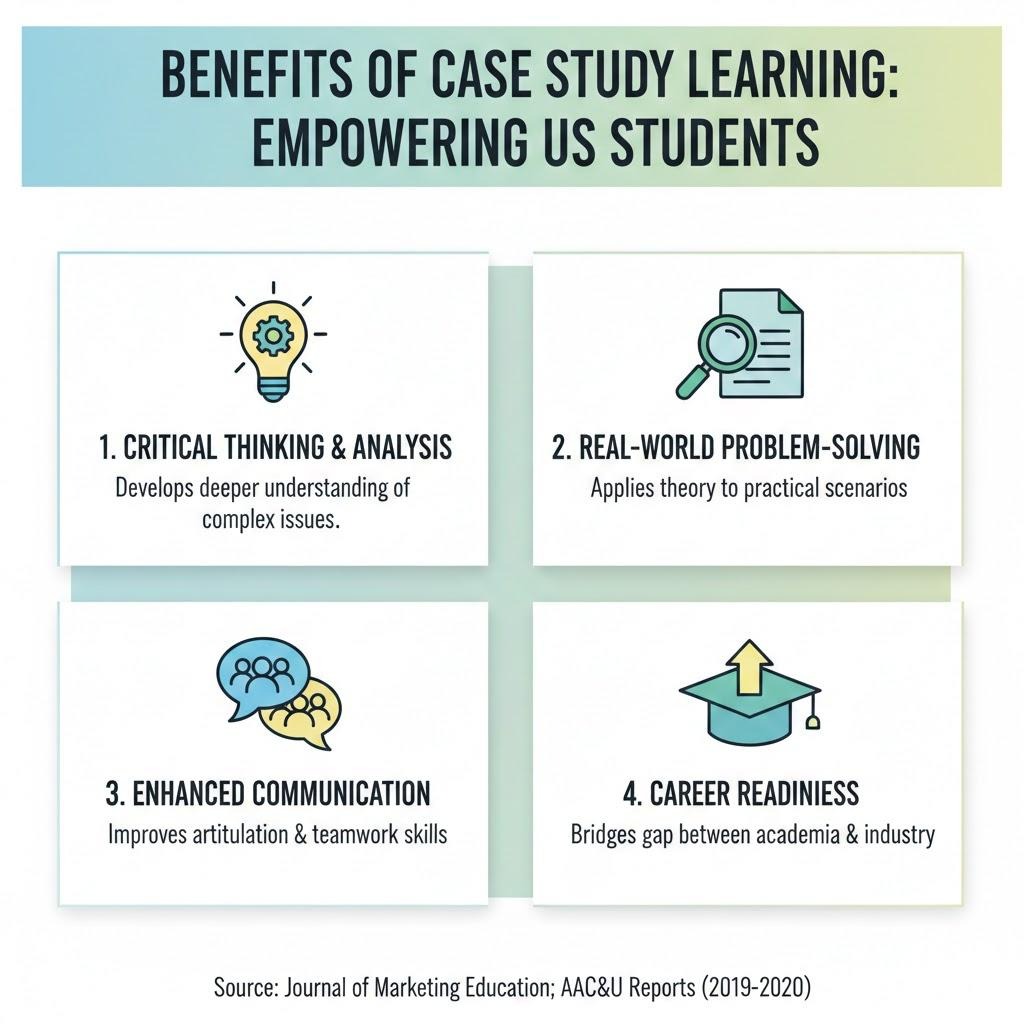
This infographic visually represents how case study learning empowers US students through critical thinking, real-world problem-solving, enhanced communication, and career readiness.
Data from the National Survey of Student Engagement (NSSE) consistently shows that students who participate in more “active and collaborative learning” strategies, which include case studies, report higher levels of engagement and perceived gains in their learning (NSSE, various years). This feedback loop reinforces the value of moving beyond passive consumption of information.
Case Studies Across Disciplines: A Universal Tool
While often associated with business schools, case studies have proven their versatility across a vast array of disciplines in US education:
- Business and Management: Perhaps the most famous application, business case studies (like those popularized by Harvard Business School) challenge students to step into the shoes of executives, analyze market dynamics, financial reports, and organizational behavior, and devise strategic plans.
- Law: Legal education relies heavily on case law, where students analyze actual court decisions to understand the application of statutes and precedents. For aspiring legal professionals, understanding business law case study examples is fundamental to mastering legal reasoning and argumentation.
- Medicine and Healthcare: Medical schools use patient case studies to teach diagnosis, treatment planning, and ethical considerations. Students review symptoms, test results, and patient histories to develop clinical reasoning skills.
- Public Policy and Social Work: Students examine real-world policy dilemmas, community challenges, and social justice issues, learning to analyze stakeholder interests, resource allocation, and ethical implications.
- Engineering and Technology: Even in technical fields, project-based case studies help students apply theoretical principles to design challenges, evaluate failures, and optimize solutions in practical contexts.
Challenges and the Future of Case-Based Learning
Despite their immense benefits, integrating case studies effectively isn’t without its challenges. It requires dedicated faculty training, access to diverse and up-to-date case materials, and often, smaller class sizes to facilitate in-depth discussion. Furthermore, the assessment of case study performance requires nuanced rubrics that go beyond simple right/wrong answers, evaluating the quality of analysis, reasoning, and proposed solutions.
Looking ahead, the future of case-based learning in the US is bright and is likely to be augmented by technology:
- Digital Case Libraries: Expansive online databases will make high-quality case studies more accessible to a broader range of institutions.
- Interactive Simulations: Virtual reality and AI-powered platforms could offer even more immersive and dynamic case study experiences, allowing students to “interact” with scenarios and see the immediate consequences of their decisions.
- Global Collaboration: Digital tools will enable students from different universities and even different countries to collaborate on international case studies, fostering cross-cultural understanding and problem-solving.
- Personalized Learning Paths: AI could potentially recommend case studies tailored to a student’s individual learning style, strengths, and areas needing improvement.
Conclusion: Preparing Students for Tomorrow’s World
The revolution brought about by case studies in modern US education is more than a fleeting trend; it’s a foundational shift towards a more effective, engaging, and career-oriented learning paradigm. By immersing students in real-world problems, case studies cultivate critical thinking, analytical prowess, and practical decision-making skills—qualities that are indispensable for success in any profession. As educators continue to innovate and embrace these methods, they are not just teaching subjects; they are building the capacity for future generations to navigate and lead in an increasingly complex world.
Sources & References:
- Association of American Colleges and Universities (AAC&U). (2020). What Works in College: How Students Can Get the Most Out of College. Washington, D.C.: AAC&U.
- McKinney, J., & Tyler, D. (2019). The Impact of Case Study Pedagogy on Problem-Solving Skills in Marketing Education. Journal of Marketing Education, 41(3), 200-212.
- National Survey of Student Engagement (NSSE). (Various Years). Annual Results. Indiana University Center for Postsecondary Research.
About the Author:
Jordan Miller is a Senior Content Specialist at MyAssignmentHelp.com, dedicated to exploring effective pedagogical strategies and academic resources that empower students in their educational journeys. With a background in educational psychology and a passion for lifelong learning, Jordan believes that bridging the gap between theoretical knowledge and practical application is key to student success. Outside of writing, Jordan enjoys mentoring aspiring scholars and staying updated on the latest trends in US higher education.